

Caedium v5 Sneak Peek: Polyhedral Meshes Improve CFD
The next release of the Caedium CFD software system will provide an option to automatically convert a RANS Flow volume mesh to a polyhedral mesh - also known as a dual mesh. Solving the RANS equations on the dual mesh compared to the equivalent tetrahedral mesh typically leads to higher accuracy results with both faster and more reliable convergence.
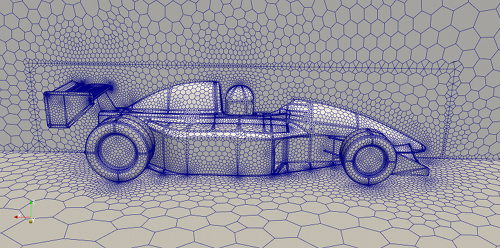 Polygon Surface Mesh
 Triangle Surface Mesh
Converting a tetrahedral mesh to a dual mesh will:
- Reduce the number of volume elements
- Increase the size of each volume element
- Increase the number of faces (cell neighbors) per volume element
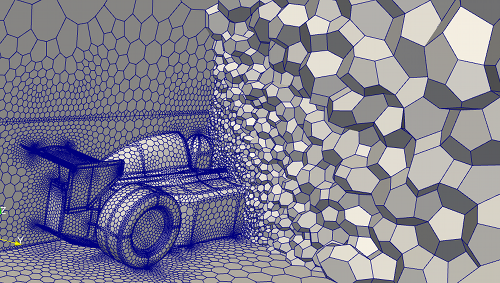 Polyhedral Volume Mesh Slice
 Tetrahedral Volume Mesh Slice
The increased element size and increased number of neighbors per element proves to be a significant benefit. If you compare the results from a tetrahedral mesh to the results from a dual mesh with the same number of cells, then the dual mesh will in general:
- Converge faster with fewer iterations
- Converge more reliably to lower residual values
- Produce results with higher accuracy
Feedback
Questions? Ideas? Problems?

Recent blog posts
- CFD Simulates Distant Past
- Background on the Caedium v6.0 Release
- Long-Necked Dinosaurs Succumb To CFD
- CFD Provides Insight Into Mystery Fossils
- Wind Turbine Design According to Insects
- Runners Discover Drafting
- Wind Tunnel and CFD Reveal Best Cycling Tuck
- Active Aerodynamics on the Lamborghini Huracán Performante
- Fluidic Logic
- Stonehenge Vortex Revealed as April Fools' Day Distortion Field
 Get our Blog feed
Comments
Caedium v5 Released
For the full story on the Caedium v5 release see "Automate CFD Simulations with Python Scripting"
There would probably be
There would probably be absolutely no practical point to doing this, but I am tempted to make an entire game using Polyhedral Meshes instead of Triangular Meshes, just because of how freaking cool Polyhedral Meshes look. I could probably even get away with not using albedo texture maps, instead using Vertex Colors.