

CFD Novice to Expert Part 4: CFD 101
Great to see that you are sticking with the series. After the previous article "CFD Novice to Expert Part 3: Fluid Dynamics 201" you are now rapidly approaching halfway, with this being part 4 of this 7 part series.
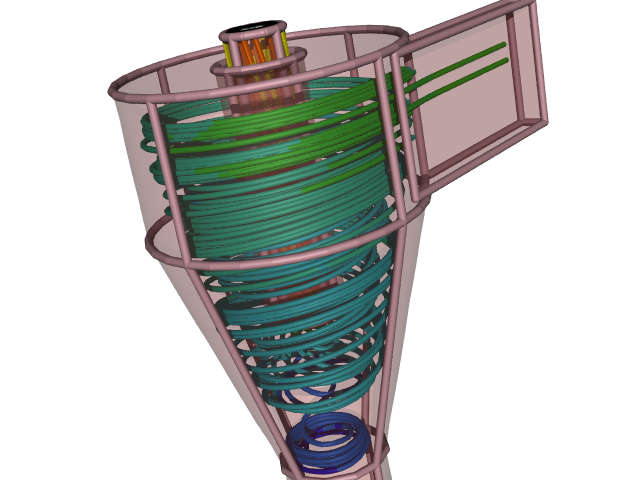 CFD Cyclone Simulation: Streamlines
CFD 101
I know - you thought this was going to be a course in CFD. Now with a base of fluid dynamics knowledge, you are ready for the juicy CFD part. As a point of reference, the Reynolds-Averaged Navier-Stokes (RANS) formulation of the governing flow equations is the most popular and practical approach to CFD for typical engineering flows with the current generation of computing resources - this is worth bearing in mind as you progress through the references presented in this section. First stop for a gentle definition and introduction to CFD is the Computational Fluid Dynamics article at Wikipedia. If you prefer your knowledge delivered by video, then try the free Boston University Introduction to CFD on iTunes.
Hopefully you come away from these introductions with an appreciation of key CFD concepts, such as geometry, meshing, material (physical) properties, boundary conditions, numerical schemes, turbulence modeling, accuracy, and flow visualization. If not, then try the more complicated but forthright descriptions in the CFD Online Wiki Reference section.
Stay tuned for part 5 - Hands-on CFD.
Feedback
Questions? Ideas? Problems?

Recent blog posts
- CFD Simulates Distant Past
- Background on the Caedium v6.0 Release
- Long-Necked Dinosaurs Succumb To CFD
- CFD Provides Insight Into Mystery Fossils
- Wind Turbine Design According to Insects
- Runners Discover Drafting
- Wind Tunnel and CFD Reveal Best Cycling Tuck
- Active Aerodynamics on the Lamborghini Huracán Performante
- Fluidic Logic
- Stonehenge Vortex Revealed as April Fools' Day Distortion Field
 Get our Blog feed