

Greenbird: World Land Yacht Speed Record Contender
Wind power, with its green credentials, is a primary force in our attempt to reduce our reliance on fossils fuels in order to reduce global warming. The majority of effort to exploit wind power is focused on converting its energy into electricity. However, if you are willing to live on the edge you'll find examples of wind energy used directly to power land-based vehicles, and very quickly in Greenbird's case - a world land yacht speed record contender.
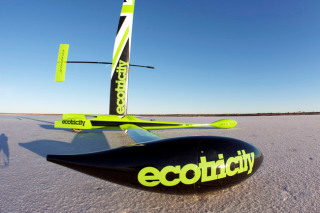 GreenbirdImage courtesy of Greenbird
While you are unlikely to see wind-powered cars any time soon on public roads there are recreational enthusiasts who are harnessing wind power for competition, speed and fun.
Land yachts - not to be confused with the gas guzzling behemoth variety, but the dry land equivalent of sail boats - have kept enthusiasts enthralled since Ancient Egyptian times. Modern land yachts come in all shapes and sizes with associated competitions and speed records.
Having built one of the largest land yachts ever, a British team led by Dale Vince (of Ecotricity) and engineer Richard Jenkins will soon (weather permitting) attempt to break the current world land yacht speed record of 116 mph (187 km/h). Their vehicle, named Greenbird, uses a rigid main wing mounted vertically instead of a traditional fabric sail to drive the vehicle. Greenbird is constructed from light-weight, but extremely strong, composite materials similar to those used in Formula 1. Greenbird also uses inverted airfoils to provide downforce to ensure it remains grounded, again borrowing from Formula 1.
The unique main wing generates lift (in the direction of motion) with minimal drag, which in theory can propel Greenbird at 3-5 times the prevailing wind speed. For their record attempt they need a large, flat and windy area. The Greenbird team favored the salt flats of Lake Lefroy, Australia in September 2008, but they were thwarted by rain in their record attempt. The team is now considering another attempt at salt flats in the US, possibly in March 2009.
I guess the failed record attempt by Greenbird just goes to show that the weather can be unpredictable and highlights why solely wind-powered land vehicles are likely to remain the preserve of dedicated enthusiasts.
Feedback
Questions? Ideas? Problems?

Recent blog posts
- CFD Simulates Distant Past
- Background on the Caedium v6.0 Release
- Long-Necked Dinosaurs Succumb To CFD
- CFD Provides Insight Into Mystery Fossils
- Wind Turbine Design According to Insects
- Runners Discover Drafting
- Wind Tunnel and CFD Reveal Best Cycling Tuck
- Active Aerodynamics on the Lamborghini Huracán Performante
- Fluidic Logic
- Stonehenge Vortex Revealed as April Fools' Day Distortion Field
 Get our Blog feed
Comments
Sail speed record.
I think you will find that an Ice Yacht set a record of 153MPH some time ago. It looks as though the 'Land' speed record has some way to go. Maybe the record books need to state that one was wind powered on Ice, while the other was on wheels ?
Land speed record is 116
Land speed record is 116 mph. Ice speed record is 143 mph. This latter record is unofficial and was 'recorded' in 1938. Many experts cite this speed as being impossible with the technology of that era, but this is the target that would-be record holders are chasing on ice.
Nick
Contender No More
As speculated at the end of the blog post, the Greenbird team led by Richard Jenkins did indeed try again on the dry plains of Ivanpah Lake, Nevada. Under ideal conditions on March 27, 2009 Greenbird reached 126.1 mph (202.9 km/h) to break Bob Schumacher's 10 year old record by 10 mph.
According to a BBC interview after his successful record breaking run on land, Jenkins is shifting his focus to the ice speed record.